
Emergency Lighting Systems in Toronto: What Building Owners Should Know
What the Ontario Fire Code asks of an emergency lighting system in Toronto, what the monthly check and annual test prove, and who answers for your building.
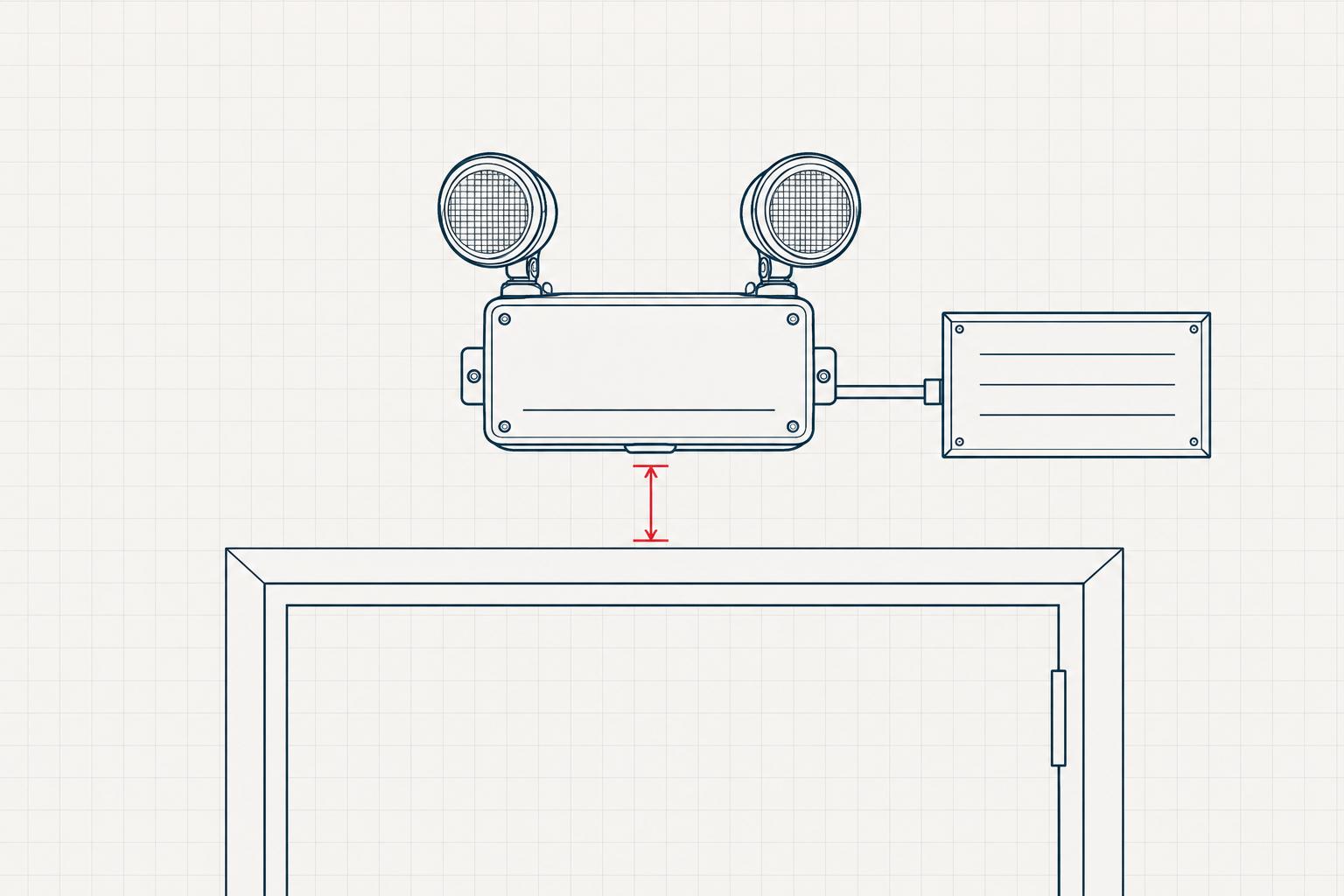
An emergency lighting system is the battery backed lighting and exit signs that keep a building's escape routes lit when normal power fails. In Toronto, the building owner carries the duty to maintain it, Toronto Fire Services enforces the Ontario Fire Code, and the system needs a monthly check and an annual test with a record kept on file.
What an emergency lighting system is
An emergency lighting system is the battery backed lighting and exit signs that keep a building's escape routes lit when normal power fails. It is separate from the lights you turn on with a switch.
Walk your own building and you can point at the parts. There is a battery unit mounted high on a corridor wall, usually with two adjustable lamp heads aimed down the hall. There is an exit sign over a door, lit green or red, with its own battery inside. In a stairwell there may be a remote head wired back to a unit on another floor. Along the path to the exit door there is at least one of these at every point where the route turns or the ceiling changes.
What the system does is light the way out. A hallway with three unmarked doors, a stairwell with one light at the far end, a rear corridor that nobody has looked at since the unit went up. Those are the places the system exists for.
Two terms come up constantly, so here they are in plain language. A battery unit is the box with the lamps and the sealed battery inside it. A lamp head is the part that actually throws light, and it can be aimed or knocked out of aim.
Who answers for it in Toronto
The building owner. Not the property manager, not the tenant, not the contractor who installed it. Those people can hold pieces of the work, but the duty sits with the owner of the building.
The rule comes from the Ontario Fire Code, which is provincial. Enforcement is not provincial. It happens locally, and the fire department that has jurisdiction is Toronto Fire Services. You will see that role shortened to AHJ, for authority having jurisdiction. It means the fire department that inspects your building and decides whether your record is acceptable.
Toronto Fire Services covers the whole city, so a Scarborough file is inspected by the same department as a downtown address. For Harex, the Toronto work is Scarborough, and it is scheduled contract work rather than emergency callout. That means the annual test goes on the calendar ahead of time, the same way it does in Durham: the test, the log, and the report. The rest of Toronto is outside the regular service area, so call and confirm the address before you count on a visit.
If you lease space, read your lease. A tenant can be assigned the maintenance obligation under a lease, and in a multi-tenant building the person who answers the phone about the log may not be the person who owns the walls. Whoever holds the file, the fire department has the final say on whether the building is compliant. Nothing in a lease changes that.
What the monthly check proves
The monthly check is a quick functional test, done in the building, by someone on site.
You press the test button on the unit. The unit should switch from normal power to its battery and the lamp heads should light. Release the button and it goes back to normal power and the battery starts recharging.
That is the whole check. It takes seconds per unit.
What it proves: the battery is connected, the transfer works, and the lamps are not burned out. What it does not prove: how long the unit will run. A battery can hold enough charge to light a lamp for ninety seconds and fail at four minutes. The monthly check passes either way.
Write down the date, the units checked, and anything that did not light. A unit that failed the press test is a deficiency, not a note for next month.
What the annual test proves
The annual test is the one that answers the real question. It is a duration test.
The unit is taken off normal power and left running on its battery for the full required duration, with the lamps lit the whole time. In Ontario that duration is thirty minutes for most buildings. The unit has to stay lit for the entire period, not most of it.
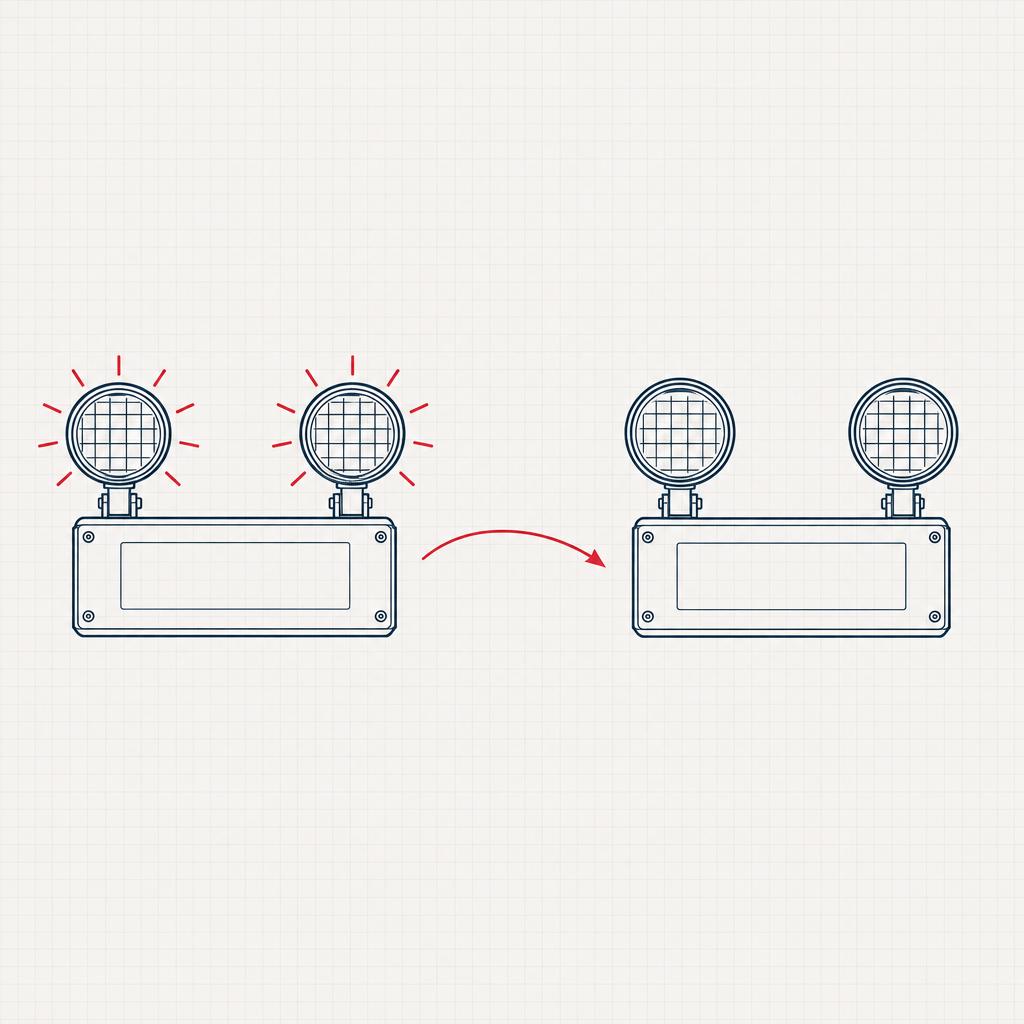
This is where a battery that passed eleven monthly checks fails. It lights, it looks fine, and it dims out at twelve minutes. You only find that by running it.
The two tests are not interchangeable, and the difference is worth keeping straight:
| Monthly check | Annual test | |
|---|---|---|
| What you do | Press the test button | Run the unit on battery for the full duration |
| How long it takes | Seconds per unit | Thirty minutes of run time per circuit |
| What it proves | Battery connected, transfer works, lamps lit | The unit stays lit long enough to empty the building |
| What it misses | Battery capacity | Nothing about capacity, but it is a snapshot |
| Who can do it | Someone on site | A technician with the test equipment and the record |
| Record | Date, units, result | Date, duration, result, deficiencies |
A unit that fails the annual test goes dark in a real outage, in a stairwell, with people in it. That is the failure the test exists to find.
The failures that come up again
The same handful of problems show up on building after building.
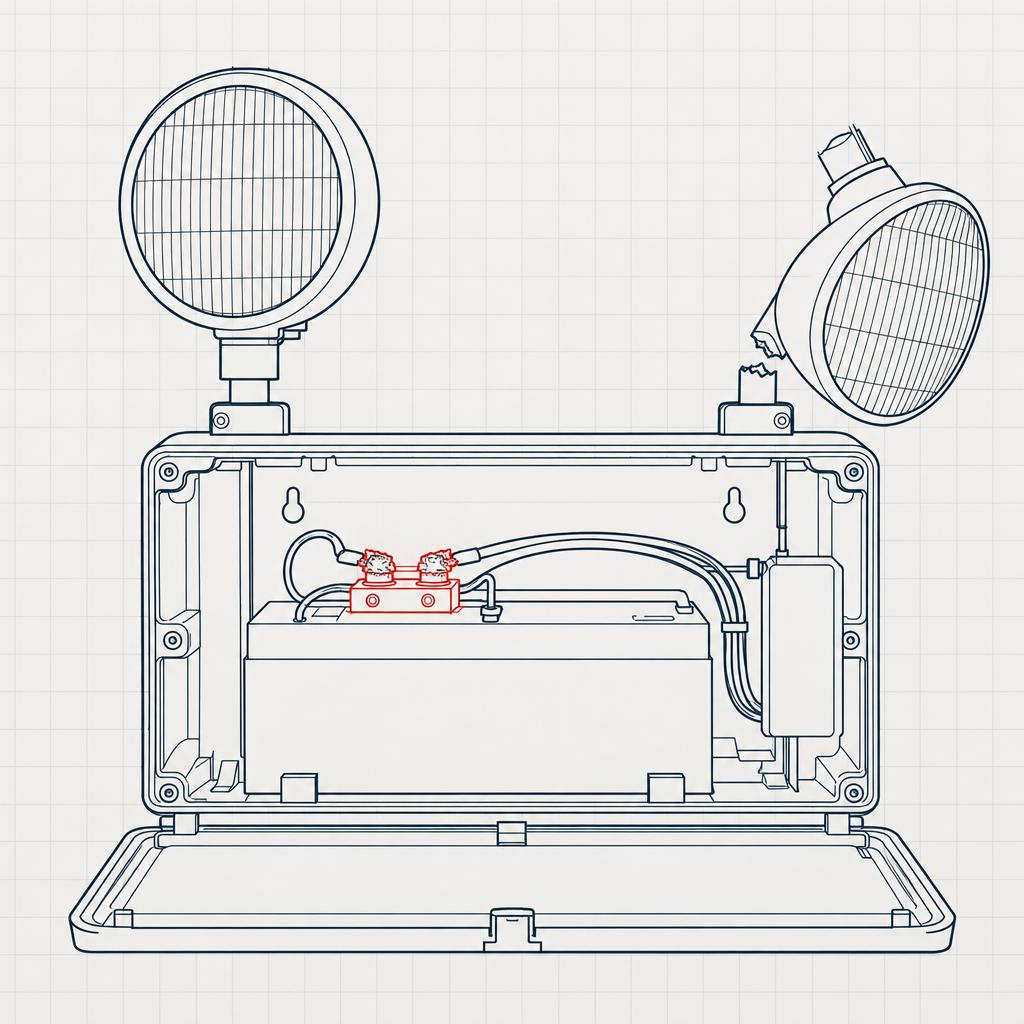
Batteries at the end of their service life. A sealed battery in an emergency unit does not last forever. It holds less each year, passes the press test, and quits early on the duration test. This is the most common failure by a wide margin.
Corroded terminals. Moisture in a parkade or a mechanical room eats the terminal block. The unit looks fine from the floor and the connection is green inside.
Damaged lamp heads. Someone knocks a head with a ladder, a cart, or a stack of boxes. The head still lights but points at the ceiling instead of down the corridor.
Units unplugged because they beeped. A unit chirps when the battery is failing. Someone unplugs it to stop the noise. A dead unit gets left on the wall, and nobody wrote it down.
Exit signs with a dark lamp. One of the two lamps in a sign goes out. From a distance the sign still reads as lit.
Units painted over or boxed in. A renovation puts a bulkhead in front of a unit, or a painter coats the lamp heads. The unit works and lights nothing useful.
None of these are exotic. They are the ordinary wear of a system nobody looks at between visits.
What the record has to show
The record is the part owners underestimate. A building with a working system and no log is in a worse position than a building with a documented deficiency and a repair date.
Keep a log for the system. It should show the monthly checks with dates and initials, the annual test with the date and the duration result, and every deficiency found with what was done about it. If a unit was replaced, the log should say so.
When the fire department inspects, the log is what they ask for first. It is also what an insurer asks for after a loss. A missing record reads the same as a missing test, because from the outside there is no difference.
A sample of six units in a forty-unit building tells you about six units. The log only means something if every unit is on it.
If you are holding an order
An order to comply with a date on it is not a document to set aside. It is the fire department telling you what it found and what it expects.
Read what it actually cites before you spend anything. Orders sometimes name a device that was already replaced, or a floor that has since been renovated. Sometimes they are exactly right and the work is straightforward. Either way, the fire department has the final say on whether the fix satisfies the order, and the conversation goes better with a record in hand.
If you are holding one, request a quote and send the order with it. If the system is fine and you want the annual test booked, the same form works.
Questions owners ask
How often does an emergency lighting system need testing in Toronto?
Two cycles. A monthly functional check, where someone on site presses the test button on each unit and confirms it lights on battery. And an annual duration test, where a technician runs each unit on battery for the full required period and records the result. The monthly check does not replace the annual test, and the annual test does not excuse you from the monthly checks.
Who is responsible if I rent out the whole building?
The owner of the building carries the duty under the Ontario Fire Code. A lease can assign maintenance work to a tenant, and in a net lease it often does, but that is an arrangement between the two of you. It does not move the obligation off the building. Toronto Fire Services will deal with the owner of record.
Can I do the monthly check myself?
Yes. It is a press of a button and a look at the lamps, and it is meant to be done by someone in the building. What you cannot do yourself is the annual duration test, because it needs the unit run on battery for the full period and a record of the result. Keep the monthly log either way. It is the first thing asked for.
What happens if a unit fails the annual test?
It gets repaired or replaced, and the deficiency goes in the log with the date it was found and the date it was corrected. A unit that fails the duration test is not going to carry people down a stairwell in an outage. Leaving it in place and hoping the next test goes better is the one option that does not hold up.
Getting the test on the calendar
Emergency lighting is easy to defer because it is quiet. It sits on the wall, it lights when you press the button, and nothing about it asks for attention until the power goes out or an inspector arrives.
Book the annual test before the date you need it, not after. Harex works out of Oshawa and covers Oshawa, Whitby, Ajax, Pickering, Courtice, Bowmanville, Clarington, Port Perry and Scarborough. Scarborough is the part of Toronto we take on, and it is scheduled contract work. If your building is anywhere else in Toronto, call and confirm the address before you plan around it. The rest of Toronto sits outside the regular service area.
Alex Harris runs Harex Inc., a family-owned fire protection company founded in 1983. He is the second generation to do so.